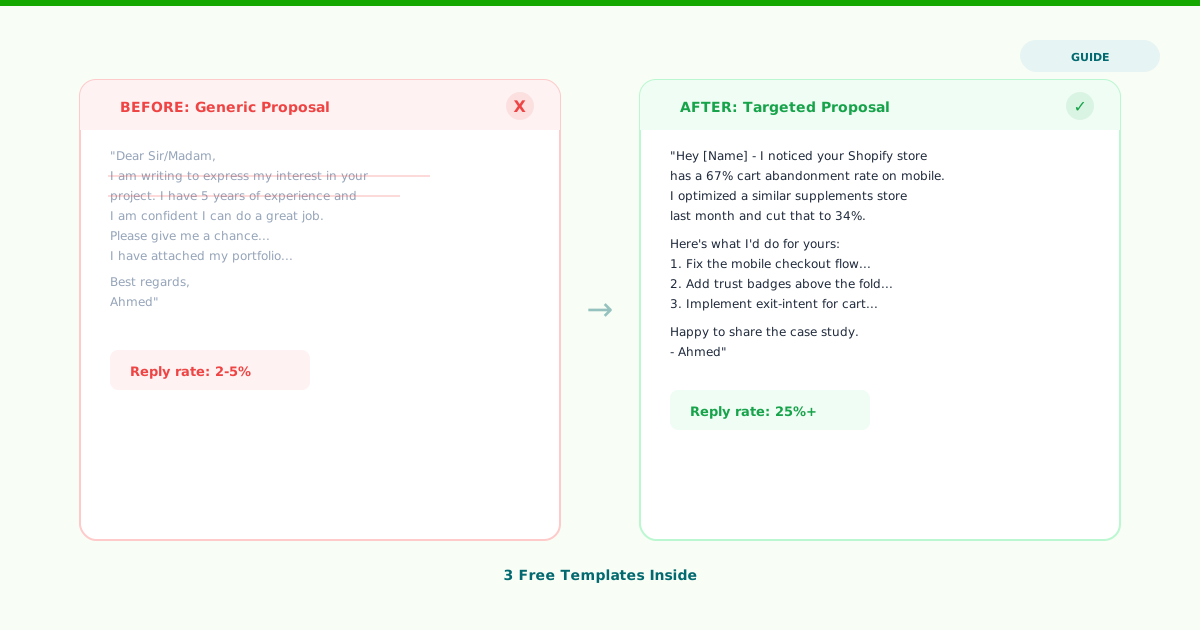
Here's a number that should bother you: the average reply rate for proposals sent by South Asian freelancers on Upwork is between 2% and 5%. That means for every 100 proposals you send, you're getting 2 to 5 responses. And most of those responses aren't even "You're hired" — they're "Tell me more" or "What's your rate?"
Meanwhile, there are freelancers from the same countries — India, Pakistan, Bangladesh — hitting reply rates of 20-30%. Same platforms, same client pool, similar skills. The difference isn't talent. It's the proposal itself.
We've reviewed over 400 proposals from South Asian freelancers who joined our program. The patterns are remarkably consistent. Almost everyone makes the same mistakes, writes the same phrases, and structures their proposals the same way. Once you see the pattern, you can't unsee it — and more importantly, you can fix it.
This article gives you the framework and three complete templates you can use today. No signup required, no email gate. Just read, adapt, and send.
The Proposal That Gets Ignored: A Dissection
Before we fix anything, let's look at what doesn't work. This is a composite of real proposals we've reviewed — the names are changed, but the language is verbatim:
Dear Sir/Madam,
I hope this finds you well. I am writing to express my keen interest in your project. I have 5+ years of experience in web development and have completed 100+ projects successfully. I am confident that I can deliver outstanding results for your project.
My skills include: HTML, CSS, JavaScript, React, Angular, Vue.js, Node.js, Express, MongoDB, MySQL, PostgreSQL, PHP, Laravel, WordPress, Shopify, WooCommerce, Python, Django, Flask, AWS, Docker, and more.
I am a hardworking individual with strong dedication to client satisfaction. I always meet deadlines and provide unlimited revisions.
Please give me an opportunity and I assure you that you will not be disappointed.
With best regards, Rajesh K. Full Stack Developer
If you recognized your own writing in that, you're in good company. Roughly 70% of proposals from India, Pakistan, and Bangladesh follow this template almost word for word. Some are longer, some shorter, but the structure and phrases are nearly identical.
Let's break down why every element of this proposal works against you.
"Dear Sir/Madam"
This is the single most common opening line in proposals from South Asian freelancers, and it's the fastest way to get ignored.
In South Asian professional culture, "Dear Sir/Madam" is the default respectful greeting. In India, you learn it in school — every formal letter starts with it. In Pakistan and Bangladesh, the same convention holds. It feels natural, polite, and professional.
To a western client, it signals three things:
- You didn't bother to find their name (it's usually on their Upwork profile)
- This is a mass-sent proposal, not a personalized one
- You're going to be stiff and formal to work with
The client's name is almost always available. Check their Upwork profile. Check the job description — sometimes they sign their name at the bottom. If you genuinely can't find a name, "Hi there" or even just "Hi" is infinitely better than "Dear Sir/Madam."
The Skills List
"HTML, CSS, JavaScript, React, Angular, Vue.js, Node.js, Express, MongoDB, MySQL, PostgreSQL, PHP, Laravel, WordPress, Shopify, WooCommerce, Python, Django, Flask, AWS, Docker..."
When you list 20+ technologies, you're trying to say "I can do anything you need." What the client actually hears is "I'm a generalist who's probably mediocre at all of these."
Western hiring psychology works differently from what many South Asian professionals expect. In India, having a long list of certifications and skills on your resume is seen as impressive — it shows breadth and dedication to learning. In western freelance culture, the opposite is true. Specialists command higher rates and more trust. A client looking for a React developer wants someone who is excellent at React, not someone who also does Angular, Vue, PHP, Python, and "more."
The fix: mention only the 2-3 skills directly relevant to this specific job. If the client needs a Shopify store built, talk about Shopify and Liquid. Don't mention Django.
"Please give me an opportunity"
This phrase appears in roughly 40% of the proposals we've reviewed from South Asian freelancers. Variations include "Kindly give me a chance," "I request an opportunity to prove myself," and "I assure you that you will not be disappointed."
In South Asian culture, this is humble and respectful. You're showing willingness and gratitude. In western business communication, it reads as desperation. The client doesn't want to give someone an "opportunity" — they want to hire someone who can solve their problem. There's a subtle but important difference between "please hire me, I need this" and "I can help you, here's how."
The reframe: instead of asking for a chance, describe what you'd do. "Here's how I'd approach your project" is a thousand times stronger than "please give me an opportunity."
"I have 5+ years of experience"
Everyone says this. Every single proposal claims years of experience and hundreds of completed projects. When everyone says the same thing, it becomes noise. The client has no way to distinguish between your "5+ years" and the next person's "5+ years."
What actually works: specific evidence. "I built the checkout flow for [specific type of client] and it increased conversions by 23%" is memorable. "I have 5+ years of experience" is forgettable.
Zero Mention of Their Project
This is the most damaging aspect of the standard proposal: it says nothing about the client's actual project. The entire proposal could be copy-pasted to any job listing on the platform. And the client knows it, because they're getting 30 other proposals that look exactly the same.
When a client posts a job, they have a specific problem. They want someone who understands that problem and can explain how they'd solve it. A proposal that doesn't mention their project is a proposal that doesn't demonstrate understanding. It goes in the "no" pile.
The "First 5 Lines" Framework
Here's the core of what we teach. Western clients spend an average of 6-10 seconds scanning the beginning of a proposal. In those seconds, they decide whether to read the rest or move on. Your first five lines determine everything.
Line 1: The Hook — Reference something specific from their job post.
Not a generic reference ("I see you need a website") but something that proves you read carefully. "I noticed your current site loads in 4.2 seconds on mobile — that's likely costing you conversions" or "You mentioned needing someone who understands the healthcare compliance space — that's exactly where I work."
Lines 2-3: The Understanding — Show you grasp their actual problem, not just their stated requirements.
Clients state requirements, but behind those requirements is a problem they're trying to solve. If someone posts "need a landing page built," the underlying problem might be low conversion rates, an upcoming product launch, or investor pressure to show growth. Show that you understand the why, not just the what.
Lines 4-5: The Proof — Mention a relevant result you've achieved, with a number if possible.
Not "I have 5 years of experience." Something like "I did this exact thing for a similar client and here's what happened." Specifics. Outcomes. Numbers.
That's the framework. Three elements. Five lines. No greeting, no "I hope this finds you well," no list of technologies. Just proof that you paid attention, you understand their problem, and you can solve it.
Related: This framework is from Pillar 1 of the SkillsToUSD system. The full program includes category-specific templates with personalization guides for every common freelance category. See the Full Program →
Template 1: Web Development Proposal
The job post: "Need a Shopify developer to fix mobile checkout issues and improve our conversion rate. We're a supplements brand doing about $40K/month but our mobile cart abandonment is really high."
The proposal:
Hey Rachel — I noticed you mentioned high mobile cart abandonment for your supplements store. That's a really common issue with Shopify themes that weren't built mobile-first, and it's usually fixable.
I worked on a similar problem for a DTC supplements brand last quarter — their mobile cart abandonment was at 67%, and we brought it down to 34% by addressing three things:
- The checkout flow required too many steps on mobile (we consolidated from 4 screens to 2)
- Trust badges and shipping info weren't visible above the fold on phones under 6 inches
- There was no exit-intent recovery — we added a simple "complete your order" email trigger
I'd want to start by auditing your current checkout flow to identify what's specifically causing drop-offs on your store. I'm happy to do that before we officially kick off — no charge. It'll take about 30 minutes and I'll share my findings in a Loom video so you can see exactly what I'm seeing.
If this sounds like a fit, I can have the audit done within 48 hours of getting access.
— Ahmed
Word count: 186 words
Why this works, line by line:
- Line 1: Uses her first name. References the specific problem she mentioned (mobile cart abandonment). Shows he understands the likely root cause.
- Lines 2-3: Cites a directly relevant result — same industry (supplements), same problem (cart abandonment), with specific numbers (67% to 34%).
- Lines 4-6: Provides a concrete three-point action plan. This tells the client "I've done this before and I know exactly what to look for."
- The offer: A free audit removes risk for the client. It's a small investment of time that demonstrates competence before money changes hands.
- The close: A clear next step with a specific timeline (48 hours). No vague "let me know" — a concrete action.
Notice what's missing: no list of technologies, no years of experience, no "please give me a chance," no "Dear Sir/Madam." Every sentence is about her problem and his solution.
Template 2: Content Writing Proposal
The job post: "Looking for a content writer for our B2B SaaS blog. We need 4 articles per month, 1,500-2,000 words each. Topics are around project management, remote work, and team productivity. SEO knowledge required."
The proposal:
Hi Marcus — I write for B2B SaaS companies in the productivity and project management space, so I know this brief well. The challenge with this niche is balancing SEO structure with readability — most SaaS blogs end up with articles that rank but nobody actually finishes reading.
A few questions that would help me understand your content goals:
- Are these top-of-funnel awareness pieces (targeting broad keywords like "how to manage remote teams") or bottom-of-funnel comparison content (targeting decision-stage searches like "Asana vs Monday.com")?
- Do you have a content calendar with topics mapped out, or would you want me to propose topics based on keyword research and content gap analysis?
- What's your review process — one round of edits, or do you prefer an outline-first approach where we align before I write the full draft?
For context, I've been writing for two B2B SaaS companies for the past 8 months — one in project management (similar to your space), one in HR tech. Typical results: articles ranking on page 1-2 for target keywords within 8-12 weeks, with an average time-on-page of 4+ minutes (which tells me people are actually reading, not just clicking).
I can share links to published pieces if you'd like to see the writing style and depth.
— Fatima
Word count: 213 words
Why this works:
- Opens with specificity: "I write for B2B SaaS companies in the productivity and project management space" — not "I am a content writer." This immediately positions her as someone who works in his exact niche.
- Shows strategic thinking: The observation about SEO vs readability demonstrates she thinks beyond just writing words. She understands content strategy.
- Asks smart questions: The three questions aren't random — they reveal experience. Only someone who's done this before knows to ask about funnel stage, content calendars, and editorial process. These questions do more to prove competence than any claim about "years of experience."
- Results with nuance: She doesn't just say "articles rank well." She mentions the specific metric (page 1-2 within 8-12 weeks) AND an engagement metric (4+ minutes time-on-page). This shows she understands that ranking is necessary but readership is the actual goal.
- Soft close: "I can share links" — not pushy, not desperate. Makes it easy for the client to take the next step without pressure.
Template 3: Graphic Design / Brand Identity Proposal
The job post: "Need a brand identity package for our new wellness startup. We're launching a line of adaptogenic supplements. Looking for: logo, color palette, typography, brand guidelines document. Budget: $800-1,500."
The proposal:
Hi Jen — wellness brands are one of my favorite categories to design for, partly because the challenge is always the same: how do you stand out when every competitor uses the same sage green, clean sans-serif, and leaf icon? There are about 400 adaptogen brands that launched last year and most of them look interchangeable.
I'd start with a 15-minute discovery call (or a questionnaire if you prefer async) to understand your positioning. The key question is where you sit on the spectrum between clinical/scientific and warm/lifestyle — that decision drives everything from color psychology to typography to photography style. A brand like Momentous looks completely different from a brand like Moon Juice, even though they sell overlapping products.
My typical process for a brand identity package:
- Week 1: Discovery + moodboard (I present 2-3 mood directions for your feedback before designing anything)
- Week 2: Initial logo concepts (3 distinct directions) + color palette and typography pairings
- Week 3: Refinements based on your feedback, then final brand guidelines document (usually 15-20 pages covering logo usage, colors, fonts, do's and don'ts, social media templates)
Here's a brand identity I completed for a UK-based wellness startup last year: [portfolio link]. The vibe might be different from what you're going for, but it shows the level of detail in the deliverables.
Happy to jump on a quick call to talk through your vision.
— Nadia
Word count: 237 words
Why this works:
- Industry knowledge on display: Mentioning the sage green / sans-serif / leaf icon problem shows she's deeply familiar with the wellness space. The reference to 400 adaptogen brands launching shows she's paying attention to the market.
- Name-drops real brands: Mentioning Momentous and Moon Juice (real wellness brands with distinct visual identities) demonstrates that she researches and understands the competitive landscape. The client immediately trusts that this designer "gets" their industry.
- Clear process with timeline: Clients hiring for brand identity work are often anxious about the process — they don't know what to expect. Laying out a week-by-week plan eliminates that anxiety and positions her as organized and experienced.
- Portfolio context: Instead of just dropping a link, she explains what the link will show and preemptively notes that the style might differ — which shows self-awareness and prevents the client from dismissing the portfolio because the aesthetic doesn't match their vision.
Before and After: The Transformation
Let's put a before and after side by side to make the difference visceral.
Before (typical proposal):
Dear Sir/Madam,
I am a skilled graphic designer with 4+ years of experience. I have worked with many clients across various industries including wellness, technology, e-commerce, and education. I am proficient in Adobe Photoshop, Illustrator, InDesign, Figma, Canva, and After Effects.
I can create logos, brand guidelines, social media graphics, flyers, brochures, and packaging designs. I am dedicated to providing high-quality work with unlimited revisions.
Please give me a chance to work on your project. I will not disappoint you.
Best regards, Imran A.
After (using the framework):
Hi Jen — I noticed you're launching an adaptogenic supplements line. The wellness supplement space is saturated right now, so your brand identity needs to do a lot of heavy lifting to differentiate you from the 400+ brands that launched last year with the same minimalist aesthetic.
I recently completed a brand identity for a functional mushroom brand targeting the same demographic — health-conscious millennials who want efficacy over aesthetics. The positioning work we did helped them stand out at a trade show where every other booth looked identical.
I'd start with a discovery session to nail down your brand positioning before touching any design software. Want me to send over my discovery questionnaire?
— Imran
Same person. Same skills. Completely different impression. The first version is forgettable. The second version makes the client think "this person understands my market."
SkillsToUSD includes proposal templates for every major freelance category — web development, content writing, design, video editing, virtual assistance, data entry, and more. Each template includes a personalization guide so you can adapt it in under 3 minutes. Starting at INR 2,999 with a 60-day money-back guarantee.
The 8 Mistakes South Asian Freelancers Make (And What to Do Instead)
Beyond the overall framework, here are specific mistakes we see repeatedly, with fixes for each:
1. Writing too much
Most proposals from South Asian freelancers are 300-500 words. The optimal range is 150-250 words. Why? Because clients are reading 30-50 proposals. They're scanning, not reading. A concise proposal that hits every point gets read. A long proposal gets skimmed or skipped.
Rule of thumb: If your proposal is longer than what fits on one phone screen without scrolling, it's too long.
2. Leading with credentials instead of relevance
"I have a B.Tech from VIT" or "I completed a Google UX Design Certificate" — these feel important because in South Asian job markets, credentials carry enormous weight. On Upwork, western clients don't care about your degree. They care about whether you can solve their specific problem.
Fix: Move credentials to your profile. In the proposal, lead with relevant experience.
3. Offering "unlimited revisions"
This is meant to show commitment and flexibility. What the client actually hears: "I'm not confident in my work, so I'll keep redoing it until you're happy." It also signals that you don't value your time.
Fix: Offer a clear revision structure. "The price includes 2 rounds of revisions, which is usually more than enough." This sounds more professional and actually sets better expectations.
4. Quoting too low to "get your foot in the door"
Many South Asian freelancers believe they need to charge bottom-of-market rates to win their first clients. The logic seems sound: undercut everyone, get the job, build reviews, then raise rates.
The problem: clients who hire at the lowest price are the worst clients. They're price-sensitive, demanding, and they'll leave you the moment they find someone cheaper. Meanwhile, you're stuck in a cycle of low-value work that doesn't build your profile in a meaningful way.
Fix: Price at the low end of the mid-range, not at the bottom. If the job budget is $500-1,500, quote $600-800 — not $200. Your proposal quality should justify the rate.
5. Not attaching portfolio samples
Many proposals we reviewed had zero portfolio links. The freelancer wrote "I have completed 100+ projects" but provided no evidence. This is the equivalent of saying "I'm a great cook" but refusing to let anyone taste your food.
Fix: Include 1-2 relevant portfolio links in every proposal. If you don't have relevant work, create a spec project. Redesign a real company's landing page. Write a blog post for a hypothetical SaaS company. Re-edit a YouTube video in your style. Spec work is real work — it shows your abilities as clearly as paid work.
6. Using formal sign-offs
"With best regards," "Yours faithfully," "Thanking you in anticipation" — these are standard in South Asian business letters but feel stiff in Upwork proposals. Western freelance communication is casual-professional.
Fix: End with just your first name. "— Priya" or "— Ahmed" is perfectly fine. If you want to add something, make it a clear next step: "Happy to hop on a call if you'd like to discuss. — Priya"
7. Applying to jobs that aren't a fit
Some freelancers send 50 proposals a day using a template. This shotgun approach produces a low reply rate and wastes time. It also trains you to write generic proposals instead of specific ones.
Fix: Send 5-10 highly targeted proposals per day instead of 50 generic ones. Spend 10-15 minutes on each: read the job post carefully, research the client's business (check their website, LinkedIn, previous hires on Upwork), and write a proposal that speaks directly to their situation.
8. Not using the "Connects" strategically
Upwork charges Connects (their internal currency) for each proposal. Many freelancers burn through Connects on every job they see. Then when a perfect-fit job appears, they don't have Connects left.
Fix: Be selective. Only use Connects on jobs where you have genuine relevant experience. Check the client's hire rate (visible on their profile) — a client with a 0% hire rate is probably not serious. Check their payment verification status. A verified payment method means they're real.
The Data: What Changes When You Fix Your Proposals
We tracked anonymized data from our community over six months. Here's what we found:
Before the framework:
- Average proposals sent per week: 35-50
- Average reply rate: 2-5%
- Average conversations per week: 1-2
- Average time to first client: 6-8 weeks
After applying the framework:
- Average proposals sent per week: 10-15 (fewer but targeted)
- Average reply rate: 22-28%
- Average conversations per week: 3-4
- Average time to first client: 2-3 weeks
The math is straightforward. Sending fewer, better proposals actually produces more conversations and faster results. Quality beats quantity every time.
Your Pre-Send Checklist
Before you hit "Submit Proposal" on any Upwork job, run through this:
- Did you use the client's name? (Check their profile if it's not in the job post)
- Did you reference something specific from their job post? (Not a generic "I see you need a website")
- Did you mention a relevant result or piece of evidence? (With a number if possible)
- Is your proposal under 250 words? (Ideally 150-200)
- Did you avoid listing every technology or skill you know? (Mention only the 2-3 relevant ones)
- Did you include a portfolio link or relevant sample? (At least one)
- Did you avoid "Dear Sir/Madam," "please give me a chance," and formal sign-offs?
- Did you end with a clear next step? ("Happy to do a quick call," "I can share more samples," "Want me to send my discovery questionnaire?")
- Does the proposal sound like it was written specifically for this job? (Could it be copy-pasted to a different job post? If yes, it's not specific enough.)
If you can honestly check all nine, you're writing proposals that are better than 90% of what's on Upwork. The templates above show you the format. The checklist ensures you hit every point. The rest is practice.
Start with your next proposal. Just one. Make it specific. Make it short. Make it about their problem and your solution. See what happens.
These 3 templates are from our full library. Inside SkillsToUSD, every template is category-specific, includes a personalization guide for fast customization, and has been tested by freelancers across India, Pakistan, and Bangladesh.
Your First USD Client Is 30 Days Away
Join 1,247+ South Asian freelancers earning internationally. The complete system includes 25 modules, 50+ templates, the Payment Bible, and weekly live Q&A.
Starting at INR 2,999 · 60-day guarantee · Lifetime access