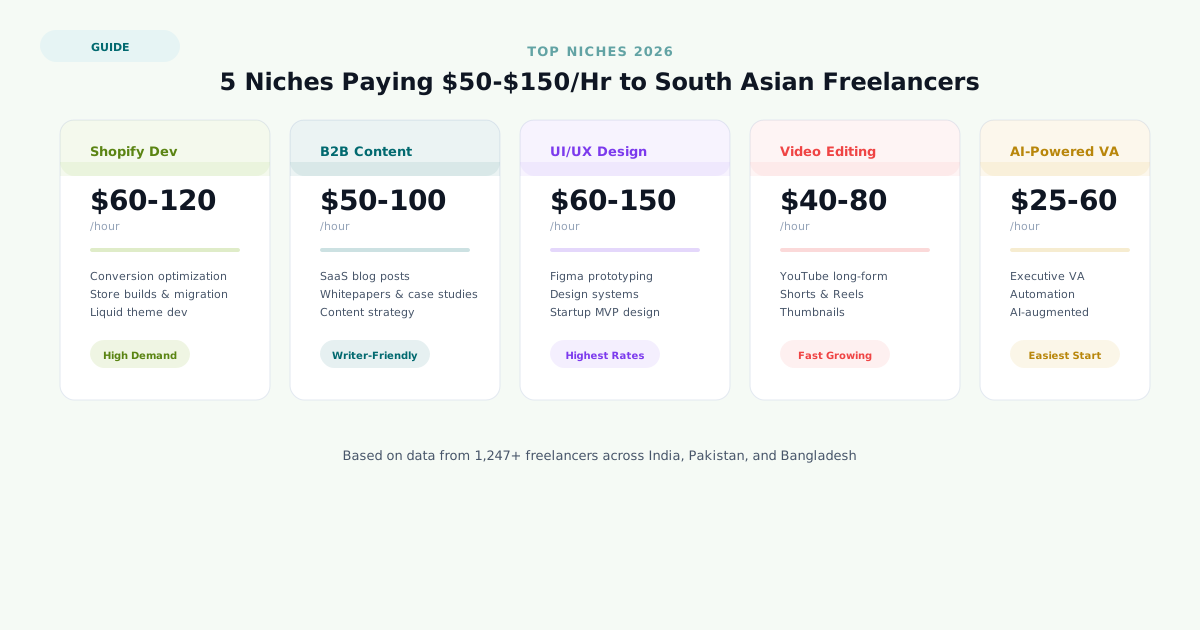
There are roughly 24 million freelancers in India alone, according to recent industry reports. Add Pakistan, Bangladesh, Sri Lanka, and Nepal, and that number swells past 30 million.
Most of them are earning between $3 and $10 per hour.
Not because they lack skill. Not because they are lazy. But because they picked the wrong niche, positioned themselves the wrong way, and ended up competing on price in a race to the bottom.
This article is about the other path. The one where you pick a niche that western businesses are desperate to fill, position yourself as a specialist instead of a generalist, and charge rates that would make your college batchmates do a double-take.
We are not talking about theoretical rates pulled from some Silicon Valley salary survey. These are rates that South Asian freelancers — people in Karachi, Mumbai, Dhaka, Lahore, Chennai — are charging right now to real clients on real projects.
Let us walk through the five niches, what makes each one lucrative, and exactly how you can break in.
What separates a $10/hour freelancer from a $100/hour freelancer?
Before we get into specific niches, you need to understand something fundamental: the rate you charge has almost nothing to do with how hard you work.
A web developer who builds WordPress sites from ThemeForest templates works extremely hard. They configure plugins, troubleshoot CSS conflicts, chase clients for content, and often put in 12-hour days. They earn $8-$15/hour.
A Shopify developer who specializes in conversion optimization for DTC (direct-to-consumer) brands works roughly the same hours. They earn $60-$120/hour.
The difference is not effort. It is three things:
- Specificity — "I build websites" versus "I optimize Shopify stores to increase conversion rates for ecommerce brands doing $1M-$10M in revenue."
- Outcome alignment — The WordPress developer sells a website. The Shopify developer sells more revenue. Clients pay more for outcomes.
- Market positioning — The WordPress developer is one of 4 million people with the same skills on Upwork. The Shopify CRO specialist is one of maybe 2,000.
Every niche below follows this pattern. You are not just picking a skill — you are picking a specific application of that skill where demand is high, supply is low, and the client's willingness to pay is through the roof because they are buying outcomes, not hours.
Niche 1: Shopify Development & Conversion Optimization
Rate range: $60-$120/hour Time to first income: 30-60 days Difficulty to learn: Moderate (easier if you already know HTML/CSS/JS)
Why this niche pays so well
Shopify powers over 4 million online stores worldwide. The platform is growing at roughly 25% year-over-year. And here is the critical part: most Shopify store owners are not developers. They are entrepreneurs, marketing people, or small business owners who set up their store using a theme and now need someone to make it actually convert.
A 1% increase in conversion rate on a store doing $500,000/year in revenue means $5,000 more per year. A 2% increase means $10,000. Store owners will happily pay $3,000-$5,000 for a project that produces those results.
What clients actually need
Forget "Shopify website development" as a service. That is the commodity version. Here is what high-paying clients are looking for:
- Conversion rate optimization (CRO): Redesigning product pages, checkout flows, and landing pages to increase the percentage of visitors who buy
- Custom theme development: Building bespoke Shopify themes using Liquid (Shopify's templating language), not just installing pre-made themes
- App integration and custom functionality: Connecting Shopify with tools like Klaviyo, Judge.me, ReCharge, or custom APIs
- Speed optimization: Shopify stores get slow with too many apps. Store owners pay well for someone who can audit and fix performance issues
- Migration: Moving stores from WooCommerce, Magento, or BigCommerce to Shopify without losing SEO rankings or data
How to learn this in 30 days
Week 1-2: Complete the free Shopify Partner Academy courses. Set up a development store (free through the Shopify Partner program). Learn Liquid basics — it is simpler than most templating languages.
Week 3: Study 10 high-converting Shopify stores in one vertical (for example, skincare or supplements). Note every design pattern: how they handle product pages, trust badges, urgency elements, cross-sells. Install tools like PageSpeed Insights and analyze their performance.
Week 4: Build one complete demo store. Pick a niche, design the product pages, optimize for speed, and document your before/after metrics. This becomes your portfolio piece.
Tools you need: VS Code with Shopify Liquid extension, Shopify CLI, Chrome DevTools, PageSpeed Insights, Hotjar (free tier for heatmaps).
Where to find clients
- Shopify Experts Marketplace: Apply to become a listed expert. It takes time to get approved, but the leads are warm.
- Upwork: Search for "Shopify" jobs and filter by hourly rate above $30. Do not compete on the $500 fixed-price jobs.
- DTC Twitter/X communities: Ecommerce founders are extremely active on Twitter. Engage with their content, share CRO tips, and DM when you see someone struggling.
- Shopify Facebook Groups: Groups like "Shopify Entrepreneurs" have 200,000+ members. Store owners post asking for help daily.
Sample project
"Redesign the product page for a $2M/year supplement brand's Shopify store. Implement A/B testing with Google Optimize, add dynamic trust badges, optimize mobile checkout flow, and improve page load time from 4.2s to under 2s."
Fixed price: $4,000-$6,000. Timeline: 2-3 weeks.
Ahmed K., one of our students in Karachi, went from $15 WordPress gigs to $3,800/month by focusing specifically on Shopify stores for fitness and supplement brands. His secret was not being a better developer — it was being a more specific one.
Related: Our Niche Selection Framework helps you pick the right high-value niche based on your existing skills and target market. See the Full Program →
Niche 2: B2B SaaS Content Writing
Rate range: $50-$100/hour (or $0.15-$0.50/word) Time to first income: 14-30 days Difficulty to learn: Moderate (you need writing skill AND the ability to learn technical topics fast)
Why this niche pays so well
Software-as-a-Service companies spend 25-50% of their revenue on sales and marketing. A huge chunk of that goes to content — blog posts, whitepapers, case studies, email sequences, landing page copy.
The problem is that most content writers cannot write about technical topics convincingly. They produce generic, surface-level content that sounds like it was written by someone who Googled the topic for 20 minutes. SaaS companies need writers who can go deep — who understand what a "customer data platform" actually does, why a CTO would choose one over another, and how to write about it without sounding like a textbook.
South Asian writers have an enormous advantage here: many have engineering or technical backgrounds. A writer with a CS degree who can explain Kubernetes to a VP of Engineering is worth five times more than a generalist blogger.
What SaaS companies need
- Long-form blog posts (1,500-3,000 words): SEO-optimized articles targeting specific keywords. Rates: $300-$800 per article.
- Case studies: Interview a customer, write a compelling story about how they used the product. Rates: $500-$1,500 per case study.
- Whitepapers and ebooks: Deep-dive reports, usually 3,000-6,000 words with original research or analysis. Rates: $1,500-$4,000 each.
- Email sequences: Onboarding flows, nurture campaigns, feature announcement emails. Rates: $100-$300 per email.
- Landing page copy: Product pages, feature pages, pricing pages. Rates: $500-$2,000 per page.
How South Asian writers can compete
Stop calling yourself a "content writer." Start calling yourself a "B2B SaaS content strategist" or a "technical content writer for developer tools."
Here is a 3-week ramp-up:
Week 1: Pick a SaaS sub-niche. Fintech? DevOps? MarTech? HR tech? Read 50 blog posts from the top 5 companies in that space. Study their tone, structure, and depth.
Week 2: Write 3 sample articles. Not for clients — for your portfolio. Pick real SaaS companies, identify keyword gaps using Ahrefs or Ubersuggest (free tier), and write articles that could genuinely rank. Publish them on your own blog or Medium.
Week 3: Start outreach. Email content managers at 20 SaaS companies. Include your samples. Offer to write one article at 50% of your target rate as a trial. Most content managers are drowning in mediocre pitches — a specific, well-written pitch with relevant samples stands out immediately.
Sample rates for context
Priya S., a content writer in our student community from Mumbai, started at $0.05/word writing general blog posts. After repositioning as a fintech content writer, she now earns $0.30/word on average and brings in $2,400/month writing 3-4 long-form articles per week for two SaaS clients.
| Content Type | Beginner Rate | Experienced Rate |
|---|---|---|
| Blog post (1,500 words) | $150-$250 | $400-$800 |
| Case study | $300-$500 | $800-$1,500 |
| Whitepaper | $600-$1,000 | $2,000-$4,000 |
| Email sequence (5 emails) | $250-$400 | $600-$1,200 |
| Landing page | $200-$400 | $600-$2,000 |
Niche 3: UI/UX Design for Startups
Rate range: $60-$150/hour Time to first income: 45-90 days (longer learning curve) Difficulty to learn: High (requires both design sense and user research skills)
Why this niche pays so well
Every startup needs a designer. Not every startup can afford to hire a full-time senior designer at $120,000-$180,000/year (the going rate in the US). Freelance UI/UX designers fill that gap — and startups are willing to pay premium hourly rates because it is still cheaper than a full-time hire.
The key word here is "UX." A graphic designer who makes things look pretty earns $15-$30/hour. A UX designer who can conduct user research, map information architecture, design user flows, create wireframes, build design systems, and hand off pixel-perfect mockups earns $60-$150/hour. The difference is the depth of the work.
What startup clients need
- Product design sprints: 1-2 week intensive design processes for new features or products. Typical project: $3,000-$8,000.
- Design system creation: Building a component library in Figma that developers can reference. This is extremely valuable because it saves the company hundreds of hours over time. Typical project: $5,000-$15,000.
- User research and testing: Conducting user interviews, usability tests, and synthesizing findings into actionable design changes. Rates: $60-$100/hour.
- Landing page and marketing design: Startups need high-converting pages for launches. Rates: $1,000-$3,000 per page.
- Mobile app design: Designing iOS and Android interfaces, often from scratch. Typical project: $5,000-$20,000.
The Figma skills that matter most
Figma is the industry standard. If you are not using Figma, you are already behind. Here is what you need to master:
- Auto Layout: The single most important Figma feature. Clients can tell immediately if a designer understands responsive design by how they use auto layout.
- Components and variants: Building reusable components with multiple states (default, hover, active, disabled, error).
- Design tokens: Colors, typography, spacing scales stored as styles that can be updated globally.
- Prototyping: Interactive clickable prototypes that clients and users can test before development.
- Dev mode: Preparing designs for developer handoff with proper specs, spacing, and asset exports.
Getting started realistically
Month 1: Complete the Google UX Design Certificate on Coursera (free with financial aid). Build 2 case study projects in Figma.
Month 2: Redesign 3 real products as practice. Pick apps with bad UX (you will find plenty), redesign them, and document your process as case studies. Post them on Behance and Dribbble.
Month 3: Apply for design projects on Toptal (selective, but high rates), Upwork (filter for $50+/hour), and reach out to startups on AngelList/Wellfound that recently raised funding — they almost always need design help.
Sara A., a graphic designer from Chittagong in our community, transitioned from logo design at $50-$100 per project to UI/UX work for SaaS startups. She now earns $2,200/month, and most of her clients are US-based startups she found through Dribbble and direct outreach on LinkedIn.
Typical project example
"Design a complete mobile app for a health-tech startup. Includes user research (5 interviews), information architecture, low-fidelity wireframes, high-fidelity mockups for 15 screens, interactive prototype, and developer handoff with a component library."
Fixed price: $6,000-$10,000. Timeline: 4-6 weeks.
Niche 4: YouTube Video Editing
Rate range: $40-$80/hour (or $150-$500 per video) Time to first income: 14-30 days Difficulty to learn: Low to moderate
Why this niche pays so well
The creator economy is a $250 billion industry. YouTube alone has over 50 million creators, and the top 500,000 of them hire editors. A single YouTuber with 100K+ subscribers typically posts 2-4 videos per week and needs someone to handle editing full-time.
Here is the math that makes this niche work for South Asian freelancers: a US-based video editor charges $75-$150/hour. A South Asian editor who produces the same quality can charge $40-$80/hour and still save the creator 40-50%. The creator is happy. The editor is earning 3-5x what they would make locally. Everyone wins.
The YouTube Shorts and TikTok explosion has made this even more lucrative. Creators now need 5-10 short-form clips per week in addition to their long-form content. That is a lot of editing work.
What creators actually need
- Long-form editing: 10-30 minute videos with cuts, B-roll, graphics, transitions, sound design, and color correction. Rates: $150-$500 per video depending on complexity.
- Short-form editing (Shorts/Reels/TikTok): 30-90 second clips cut from long-form content or filmed specifically for vertical platforms. Rates: $25-$75 per clip.
- Thumbnail design: Many editors also design thumbnails. This is an easy upsell. Rates: $15-$40 per thumbnail.
- Motion graphics: Animated intros, lower thirds, custom graphics, kinetic typography. This is the premium tier. Rates: $50-$100/hour.
Tools you need
Essential (free or low-cost):
- DaVinci Resolve (free version is genuinely professional-grade)
- CapCut (free, excellent for short-form content)
- Canva (for thumbnails if you are not a Photoshop user)
Professional tier:
- Adobe Premiere Pro ($21/month with Creative Cloud)
- After Effects (for motion graphics, $21/month)
- Final Cut Pro (Mac only, one-time $300)
You do not need all of these. Start with DaVinci Resolve. It is free, it is powerful, and it is used by Hollywood editors. There is no shame in using free tools — your clients care about output quality, not which software icon is in your dock.
Where to find creator clients
- YouTube itself: Watch videos in niches you enjoy (business, tech, fitness, gaming). Look for creators with 50K-500K subscribers whose editing quality is inconsistent. Reach out via email (usually in their About page) or Instagram DMs.
- Creator-specific job boards: Sites like YTJobs.co and CreatorJobs post editing positions regularly.
- Twitter/X: Search "looking for video editor" — creators post these requests weekly.
- Reddit: r/youtubers, r/NewTubers, r/VideoEditing — creators post hiring requests.
Realistic timeline
Week 1-2: Learn the basics of DaVinci Resolve or your chosen tool. Edit 3 sample videos using royalty-free footage (Pexels, Pixabay).
Week 3: Study the editing style of 5 popular YouTubers in your chosen niche. Recreate their style using their own footage (download, re-edit, and use as a portfolio piece — label it clearly as a "spec edit").
Week 4: Reach out to 20 creators. Offer to edit one video for free or at a steep discount as a trial.
Vikram R., a video editor from Chennai in our student community, started with zero editing experience. Within 4 months, he was editing for two YouTube creators in the personal finance niche and earning $2,700/month. His breakthrough was creating spec edits for creators he admired and sending them cold DMs.
SkillsToUSD includes niche selection frameworks, client outreach templates, and pricing calculators for all 5 of these niches. Starting at INR 2,999 with a 60-day money-back guarantee.
Niche 5: AI-Augmented Virtual Assistance
Rate range: $25-$60/hour Time to first income: 7-21 days Difficulty to learn: Low (but the "AI-augmented" part is what differentiates you)
Why this niche is different from regular VA work
Traditional virtual assistants handle email, calendar management, data entry, and basic admin tasks. They earn $3-$8/hour from Upwork and similar platforms. It is the definition of a race to the bottom.
AI-augmented VAs are something entirely different. They use tools like ChatGPT, Claude, Zapier, Notion AI, and automation platforms to handle 5-10x the workload of a traditional VA — and they position themselves accordingly.
Instead of "I will manage your inbox," the pitch becomes: "I will build an AI-powered system that triages your inbox, drafts responses for 80% of emails, auto-schedules meetings based on your preferences, and surfaces only the 20% of messages that need your personal attention. Then I will manage that system and handle the remaining 20% personally."
That is not a $5/hour service. That is a $40-$60/hour service because you are selling a system, not just your time.
The "Executive VA" positioning
The key is to stop calling yourself a virtual assistant. Use titles like:
- Executive Operations Assistant
- Chief of Staff (Fractional)
- Operations Manager
- Business Operations Specialist
These titles attract clients who are willing to pay more because they are looking for strategic support, not just task completion.
AI tools that 10x your output
Here is the stack that separates a $5/hour VA from a $40/hour Executive Operations Assistant:
| Task | Traditional VA Approach | AI-Augmented Approach |
|---|---|---|
| Email management | Read and reply manually | Use ChatGPT to draft responses, Gmail filters + Zapier for auto-triage |
| Research | Google search, copy-paste into docs | Claude for deep research synthesis, Perplexity for sourced answers |
| Meeting notes | Attend meetings, type notes | Otter.ai or Fireflies for transcription, ChatGPT for summaries and action items |
| Social media | Manual posting | Buffer/Hootsuite + ChatGPT for caption writing, Canva AI for graphics |
| Data entry | Manual input | OCR tools + Zapier automations, Google Sheets AI features |
| Travel booking | Search flights manually | Kayak + ChatGPT for itinerary optimization, Google Flights price tracking |
| CRM management | Manual data updates | Zapier integrations between email, calendar, and CRM |
How to upsell from basic VA work
This is the most accessible niche on this list because you can start with basic VA work (to get your foot in the door and build trust) and then upsell to higher-value services.
Phase 1 (Weeks 1-4): Take on 1-2 VA clients at $10-$15/hour doing standard admin work. Use AI tools privately to complete work faster than expected.
Phase 2 (Weeks 5-8): Show your clients what you have built. "Hey, I noticed you spend 2 hours a day on email. I set up a system using Zapier and AI that could cut that to 20 minutes. Want me to implement it?" Now you are providing consulting value, not just task value.
Phase 3 (Weeks 9-12): Raise your rates to $25-$40/hour and position new proposals around the systems you build, not the hours you work. Take on 2-3 clients at the higher rate.
Where to find Executive VA clients
- Belay, Time Etc, Boldly: These agencies place VAs with executives and pay $15-$25/hour (they charge clients $35-$60/hour). Good for building experience.
- Upwork: Search for "executive assistant" or "operations manager" — not "virtual assistant."
- LinkedIn: Connect with startup founders and solopreneurs. These people are overwhelmed and actively looking for operational support.
- Facebook Groups: Groups like "Virtual Assistant Savvies" and "The VA Handbook" have job postings daily.
Riya M., a social media manager from Delhi in our student community, added AI-augmented VA services to her offerings and went from managing only social accounts at $800/month to providing full operations support at $2,100/month for two clients.
The common thread: specificity wins
Look at these five niches again. Notice what they have in common:
Each one solves a specific, expensive problem. Not "I do web development" but "I optimize Shopify conversion rates." Not "I edit videos" but "I edit for YouTube creators posting 3x/week."
Each one aligns with outcomes clients care about. More revenue (Shopify). More organic traffic (SaaS content). Better user experience (UI/UX). More content output (video editing). More time back (Executive VA).
Each one has a clear learning path. You do not need a degree or five years of experience. You need 30-90 days of focused learning and 2-3 portfolio pieces.
Each one is accessible from South Asia. All the work is remote. All the tools are available globally. Payment can be handled through Wise, Payoneer, or direct bank transfer.
The freelancers earning $50-$150/hour are not smarter than you. They are not more talented. They simply made better positioning decisions. They picked a niche where demand exceeds supply, positioned themselves as specialists instead of generalists, and communicated their value in terms of outcomes instead of hours.
What to do right now
Pick one niche from this list. Not two. Not three. One.
Then spend the next 7 days doing nothing but research. Read everything you can about that niche. Study the top freelancers already working in it. Look at their portfolios, their LinkedIn profiles, their Upwork profiles. Note how they describe their services, what they charge, and how they structure their proposals.
After 7 days of research, you will know whether the niche is right for you. If it is, commit to 30 days of focused skill-building. If it is not, pick another one and repeat.
The worst thing you can do is stay a generalist. The "I do everything" freelancer earns less than the "I do one thing extremely well" freelancer. Every single time.
The numbers do not lie. And neither do the freelancers from South Asia who are already earning these rates. The only question is whether you are willing to do the work to join them.
Your First USD Client Is 30 Days Away
Join 1,247+ South Asian freelancers earning internationally. The complete system includes 25 modules, 50+ templates, the Payment Bible, and weekly live Q&A.
Starting at INR 2,999 · 60-day guarantee · Lifetime access